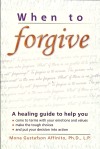
Today I’m adding the final bulleted suggestions on helping someone decide how to handle a forgiveness issue. All are from pages 4-5 of When to Forgive . Please remember, this is not about a command to forgive. Telling someone to forgive is dangerous. It might result in a quick recitation of “I forgive” without the hard work behind it and accomplishment of the real and important gains of a good forgiveness decision. Shame might be added to the pain of suffering an offense if the victim believes in the “ought to forgive” and can’t. That’s the hazard of sermons — religious or otherwise — that tell the sufferer he or she must forgive. Realistically there may be actions the sufferer must take before genuine forgiveness. Or, it’s even possible that the sufferer might be better off choosing not to forgive. “When to Forgive” is about making and carrying out a decision after careful thought and work.
So, here goes,the final complete list of what you might do to help someone trying to deal with the pain of an offense as he or she considers the forgiveness option.
- Be a good listener. Telling his or her own story is absolutely crucial to a person’s recovery from the effects of an offense. Encourage giving details, but don’t press your own advice or suggestions. Ask questions that encourage going into depth, but be sensitive to the person’s own self-regulating system. Don’t push beyond what he or she is ready to report. There are situations of extreme trauma where the victim is better off not remembering what happened.
- When your friend is asked to ‘probe the wound,’ ask for as much detail as possible. In fact, you may know the situation well enough that you can remember some things your friend has forgotten. But let your friend be in control of how much he or she can tolerate.
- You can discuss and help clarify, but don’t impose your own view. You can also help your companion fend off the efforts of others to dictate their beliefs.
- Your friend making the journey may want you to provide some feedback. Sometimes you may observe things that he or she doesn’t readily see. Often it’s the positives that people have difficulty identifying in themselves.
- As the book progresses, you can serve by moving beyond being the effective listener to being a good discussant. Perhaps you’ll be invited to talk over some ideas presented in the problem-solving phase. Remember to take direction from your friend; let the sufferer tell you how active he or she wants you to be in offering ideas.
- As your friend moves closer to making a decision, the fact that you are familiar with the offense that has occurred, and the people involved, makes you a good potential resource for considering the practicality of any punishment options that may be considered.
- You may gain some insights about yourself in this process and want to get feedback on what you are learning. But remember the focus is on helping to heal the person who suffered the offense.
Today I’m adding the fourth bulleted suggestion from pages 4-5 of When to Forgive. First, though, a reminder. This is not about a command to forgive. Telling someone to forgive is dangerous. It might result in a quick recitation of “I forgive” without the hard work behind it and accomplishment of the real and important gains of a good forgiveness decision. Shame might be added to the pain of suffering an offense if the victim believes in the “ought to forgive” and can’t. That’s the hazard of sermons — religious or otherwise — that tell the sufferer he or she must forgive. Realistically there may be actions the sufferer must take before genuine forgiveness. Or, it’s even possible that the sufferer might be better off choosing not to forgive. “When to Forgive” is about making and carrying out a decision after careful thought and work.
So, here goes, more on what you might do to help someone trying to deal with the pain of an offense as he or she considers the forgiveness option.
- Be a good listener. Telling his or her own story is absolutely crucial to a person’s recovery from the effects of an offense. Encourage giving details, but don’t press your own advice or suggestions. Ask questions that encourage going into depth, but be sensitive to the person’s own self-regulating system. Don’t push beyond what he or she is ready to report. There are situations of extreme trauma where the victim is better off not remembering what happened.”
- When your friend is asked to ‘probe the wound,’ ask for as much detail as possible. In fact, you may know the situation well enough that you can remember some things your friend has forgotten. But let your friend be in control of how much he or she can tolerate.
- You can discuss and help clarify, but don’t impose your own view. You can also help your companion fend off the efforts of others to dictate their beliefs.
- Your friend making the journey may want you to provide some feedback. Sometimes you may observe things that he or she doesn’t readily see. Often it’s the positives that people have difficulty identifying in themselves.
I confess, I’m pro-life. Therefore I’m pro-choice; pro Planned Parenthood; pro-gun control; anti-death penalty; pro habeas corpus; pro universal health care; pro caring for the environment; anti-war; pro-diplomacy; pro equalizing education opportunities; pro caring for our national and local infrastructure; pro Public Radio; pro being an informed voter; pro a rational and humane immigration policy. Also I’m pro separation of church and state; anti-torture; pro promoting the general welfare (see preamble to the constitution of the United States); pro equality for women; pro protecting the vulnerable, pro recognizing that “defense” and “war” are not synonyms.
Obviously I’m an idealistic dreamer. Still, I’d love to see the positions of all candidates for public office on health care, gun control. response to climate change, repairing the infrastructure, torture — i.e. all of the above. Hint: I don’t consider it a “position” to rant against the stance of one’s opponents no matter which side one is on.
OK. Tomorrow it’ll be back to business –Helping with Forgiveness Decisions.
Today I’m adding the third bullet to the guides for someone who’s trying to help a friend or acquaintance work through the issue of whether and how to forgive. Maybe to get oriented, you might want to read the blog from two days ago.
Following are the first three suggestions for the helper from pages 4-5 of When to Forgive..
- Be a good listener. Telling his or her own story is absolutely crucial to a person’s recovery from the effects of an offense. Encourage giving details, but don’t press your own advice or suggestions. Ask questions that encourage going into depth, but be sensitive to the person’s own self-regulating system. Don’t push beyond what he or she is ready to report. There are situations of extreme trauma where the victim is better off not remembering what happened.”
- When your friend is asked to ‘probe the wound,’ ask for as much detail as possible. In fact, you may know the situation well enough that you can remember some things your friend has forgotten. But let your friend be in control of how much he or she can tolerate.
- You can discuss and help clarify, but don’t impose your own view. You can also help your companion fend off the efforts of others to dictate their beliefs.
Over the next few days I’ll be adding more bullet points. In the meantime, I’d love some feedback. Examples of helping or being helped would be wonderful.
Today I’m adding the second bullet to the guides for someone who’s trying to help a friend or acquaintance work through the issue of whether and how to forgive. Maybe to get oriented, you might want to read yesterday’s blog.
Following are the first two suggestions for the helper from pages 4-5 of When to Forgive..
- Be a good listener. Telling his or her own story is absolutely crucial to a person’s recovery from the effects of an offense. Encourage giving details, but don’t press your own advice or suggestions. Ask questions that encourage going into depth, but be sensitive to the person’s own self-regulating system. Don’t push beyond what he or she is ready to report. There are situations of extreme trauma where the victim is better off not remembering what happened.”
- When your friend is asked to ‘probe the wound,’ ask for as much detail as possible. In fact, you may know the situation well enough that you can remember some things your friend has forgotten. But let your friend be in control of how much he or she can tolerate.
Over the next few days I’ll be adding more bullet points. In the meantime, I’d love some feedback. Examples of helping or being helped would be wonderful.
I’ve been so wrapped up in Mrs. Job lately that It’s been a while since I wrote about forgiveness, still one of my favorite concerns. So, I’m starting a series based on pages 4-5 of When to Forgive. This is what I said under the section “Welcoming a Friend,” speaking to the person who has suffered an offense and is working toward making a forgiveness decision.
“You may want to invite a friend to accompany you on this journey. Someone you trust and who knows you and your situation well can ease the pain along the way while offering helpful insights. If you wish to share this book with a friend, the following advice is specifically for your companion.
• Be a good listener. Telling his or her own story is absolutely crucial to a person’s recovery from the effects of an offense. Encourage giving details, but don’t press your own advice or suggestions. Ask questions that encourage going into depth, but be sensitive to the person’s own self-regulating system. Don’t push beyond what he or she is ready to report. There are situations of extreme trauma where the victim is better off not remembering what happened.”
Over the next few days I’ll be adding 6 more bullet points. In the meantime, I’d love some feedback. Examples of helping or being helped would be wonderful.
As I understand it, the basic position of the Tea Party Folks is that we should all be responsible for ourselves. Yet they oppose the Individual Mandate which requires exactly that. Without it, the responsibility for the medical care of the uninsured and their children lies with the tax money provided by the rest of us. Unless, of course, the position is that the uninsured should receive no medical care.
And a reminder of the real Palestinian/Israeli situation as well. Thanks to Sojourners, one of my favorite magazines, whose title reminds me that we are all just traveling through. fighting-real-enemy-fear#.UAxTUt8t6-w.facebook
When it comes to the big things, I don’t make decisions. I’ve found that I give myself clues to my direction by watching what I do. For example, when I buy a car (every 12 years or so) I don’t decide, “Oh, it’s time to get a new car,” Well, that’s not quite true, when I traded in my Starion in 2002 it was because it needed expensive repair for the first time in its some 16 years. But when I bought the Starion I realized that I’d been looking at automobile ads with special interest for some time. “Aha!” I said to me, “there must be a reason why you’re doing this. I guess it’s time to buy a new car.”
And then there’s moving, as in leaving Connecticut for Minnesota. Oh, I had done a lot of spadework – even bought a house here and rented it under control of a leasing agent. But it was 2:00 a.m. one April morning that I said to myself, “OK. I’m moving in November or December.” I started telling my clients that I’d be leaving. That’s when I learned that things can move pretty fast with a deadline. I also told potential clients my plan, offering to give them a referral if they wanted longer-term work. Only one person asked for a referral. One potential client even said, “Good. I hate psychologists anyway.” We did get things done in a hurry. On her way out of our last session she thanked me for being the only therapist who ever helped because “You tell it like it is.” (If you know me personally and want to ask in private, I’ll tell you how that worked.)
Then there was the move out of that first Minnesota home. Partly it was my own behavior, and partly it was the snow and ice that clogged my garage door at the bottom of the steep driveway. “Wouldn’t it be fun,” I thought, “just to see what’s available around here.” Smart real estate agent. She knew better than I did what I wanted. In no time at all I had made a deposit on my current home and sold my ice collector. I love it here.
But here’s my question. What am I telling myself now? In the past three days I’ve stuffed my recycling bin with the contents of twenty business-size three-ring notebooks and purchased $32.00 worth of shredding. Gone are my teaching notes and materials for the workshops I used to do on “Forgiveness,” “A Healthy Woman is a Crazy Person,” and “Stress.” Am I subconsciously planning to move? I don’t think so. Am I accepting that I’m retired enough that I can spend my time hanging out with good books and traveling? It’s a possibility. Am I clearing a path for more devotion to writing? It could be. Is some new career creeping up on me? Maybe.
As soon as I know the answer, I’ll let you know, whether you ask for it or not.



 monagustafsonaffinito