Archive for the ‘Uncategorized’ Category
Where does time go? It was Sunday, June 1, 2014 that we saw “Our Country’s Good” at the Guthrie. My understanding of it was greatly enhanced by what I had learned from the Australian bloggers I follow. My intention at the time was to thank you who contributed to my appreciation. Sorry I’ve been delayed by so many other things that needed doing.
I had visited Port Arthur, where one guide told us about the wonderful things that were done to integrate prisoners into normal life. Another guide told us the treatment of prisoners was cruel. Of course, one assumes the truth lies somewhere in between.
At any rate, mixing that experience with what I’ve learned here, I had a much richer understanding of the theme. On the surface it was the story of how producing and acting in a play humanized the prisoners. Behind it was the story of man’s inhumanity to man, the dehumanizing and brutalizing of criminals thought to be genetically evil, the belief in the natural superiority and authority of the keepers of the prisoners colored by the reality that they too were essentially imprisoned by their roles, and the basic fact that providing people with the opportunity to employ and be respected for their abilities arouses the humanity in all.
Sorry. That’s a run on sentence which, however, conveys the entangled richness of the play. Besides helping to understand the politics of the play, knowledge of the “weirdness” of nature in that place helped to enhance the picture.
All in all, this is an expression of gratitude to you Australians who know who you are. Obviously your efforts are not in vain.
GETTING BACK TO THE WEEKEND OF MAY 31/JUNE 1 THAT IS.
It was such an active weekend with the “Top Coast Festival” through Sunday morning, and then “Our Country’s Good” matinee at the Guthrie. There was so much I wanted to continue to share.
Personally, I prefer shorter posts, so I’ll save the explanation of what delayed my getting back to you and pick up where I left off with Ezekiel J. Emanuel’s book. Reinventing American Health Care: How the Affordable Care Act Will Improve our Terribly Complex, Blatantly Unjust, Outrageously Expensive, Grossly Inefficient, Error Prone System. New York: Public Affairs.
I’ve managed to finish reading 158 pages. First a description of the disorganized growth of our extremely complex health care system up to the beginning of work on the “Affordable Care Act” and then “The Surprising History of Health Care Reform in the United States.” As I testified previously, I’m glad I don’t have to take a test on the extremely confusing facts. A few things stood out, though.
(1)That health care in the U.S. is a Three Trillion Dollar industry, bigger than the entire economy of France.
(2)That the high price of health care drains resources from other essential services, like education.
(3)That the first attempt to see that all Americans had health care was made by President Teddy Roosevelt.
(4)That near misses have been thwarted in the past by unrelated Washington scandals sidetracking bipartisan plans.
OK, I said I want to keep it short. Just one more thought. If I can’t pass a test on all the facts, then I can’t be so bold as to support or suggest solutions. I can point out, though, the preamble to our constitution.
We the People of the United States, in Order to form a more perfect Union, establish Justice, insure domestic Tranquility, provide for the common defence, promote the general Welfare, and secure the Blessing of Liberty to ourselves and our Posterity, do ordain and establish this Constitution for the United State of America.
Now there’s a tall order if I ever saw one. At any rate, I can’t help noticing how important a healthy populace is to all those goals. If that’s true, then finding an effective and just health care system is a pretty important goal for ”ourselves and our Posterity.”
Of course, as you might guess, I am also influenced by my attempt to be “a follower of the Way” and the subsequent belief we cannot rest until all people, young and old, have fair access to the possibilities for good health.
Next time I’ll post a thank you for our blogging Australian friends for enriching my understand of the play “Our Country’s Good.”
August 24, 2009. I was waiting outside my hotel in Hamden, Connecticut for a ride to my former husband’s Wake when a car pulled up in front of me and a woman leapt out, waving some papers. “This is terrible! Have you seen what this guy wants to do? This health care thing! It’s awful! “
I guess my reaction was not as powerful as she would have liked, so she went on. “Have you read it?’ Picturing a 3000-page document typical of such legislation, I indicated I had not. “Well, she said, I have – all 119 pages, and it’s just awful!”
At that point Lou’s niece drove up to take me to the wake. I never did find out where those 119 pages came from to which the woman was referring. All I know is, they must have been someone’s summary – oversimplified summary.
May 31 – June 1, 2014 I attended an amazing weekend called “Top Coast Festival” at the University of Minnesota, co-sponsored by Minnesota Public Radio. Someone explained the name came from the fact that Minnesota is neither East Coast nor West Coast, but “Top Coast.”
At any rate, there was so much I’d like to share, but one piece at a time. I’ve included the link to the program in case you are interested/curious.
I try to resist buying the back-of-the-room books. Mostly what my unread books are doing is creating a stack high enough to serve as a table. But there were two I couldn’t resist. This post is based on one of them. The interview was just too fascinating to pass up the author’s book.
Emanuel, Ezekiel J. (2014) Reinventing American Health Care: How the Affordable Care Act Will Improve our Terribly Complex, Blatantly Unjust, Outrageously Expensive, Grossly Inefficient, Error Prone System. New York: Public Affairs
I have actually read 85 pages of the 124 page “Part I: The American Health Care System.” I thought I knew something about it as a practitioner. Now all I can say is “Thank goodness I don’t have to take a test on the hodgepodge that has developed over time as the American Health Care System.” Moreover, I’m impressed with the job our lawmakers have in sorting through the morass.
The data say it all. We do have a “Terribly Complex, Blatantly Unjust, Outrageously Expensive, Grossly Inefficient, Error Prone System” that needs fixing.
All I ask as the purpose of this posting is for people to avoid making uneducated decisions. Oh yes! They have to be uneducated unless one is willing to plow through the history and the data with the kind of attention you’d give if you were preparing for an exam. But please don’t accept the one-liners our political ads and media snippets have to offer.
There are things we can learn if we are willing to make the effort.
Not a big deal, or maybe it is. No, it really is petty, but I have a gripe today – well, I have it often, but it was evoked today with my trip to Curves. I’m so far from being athletic you could say I extend the normal curve like a snake way off to the left. But I do try to get to Curves three times a week for what amounts to a workout.
If you’re familiar with the place, you know there is a large circle of workout machines. (I think 12. Next time I go I’ll count them.) In between there are “recovery stations” where you can do whatever you want – walking or jogging in place, flinging your arms around, bending and stretching – whatever. And it’s all timed. 30 seconds on a machine, 30 seconds on recovery.
For most of us who pay the small extra fee, the intensity of our workout is recorded on a computer which, at the end of two plus cycles, tells us how we did. Something to strive for. As for me, the hard part is getting myself there. The joyful part is seeing the end.
So, about community and closeness. If I were doing a more serious blog, I’d be ranting about the importance of encouraging community, cooperation, empathy, working together, appreciating each other’s differences, overcoming greed. In other words, I think community is our hope for the future and appreciation of things past.
But It also means respect for our individuality. And that’s what set me off today. When I arrived this morning, there was one other person working out, so I chose to start on a machine at a distance from where she was so as not to crowd her. I was happily (well, dutifully) working my way around the circuit when another woman arrived and started her circuit right next to me. Now, if there ‘s a huge crowd there, options are few. Bu she had plenty of room.
What it meant was I had to stand and wait for her to finish, or work my way around her to a different spot – not the best way to keep the computer informed.
Actually, she seems to be a lovely lady. So what is it when people seem not to be aware they are crowding others?
Now that I’m on a roll, how about the light at the intersection of highways 41 and 5? (Or wherever your example may be.) Those of us who drive there often know the green light lasts just long enough for three, maybe four cars to get through. I’m OK with that. It’s a busy intersection. But I do try to be alert if I’m first in line so I move as soon as I’ve taken a quick look left to make sure no one is running the red light against me. I’m not perfect at it, but it seems to me like an act of respecting other people’s need to get through the intersection. My gripe? Folks who are first in line who seem not to be aware that the fate of others depends on them and, for want of a better word, dawdle for one reason or another. Leaving those a few cars behind them waiting again through the whole cycle before they can get through.
One more example of failure to respect personal space. The person whose own personal space is minimal, so he or she drives you into a corner as you try to maintain your polite distance in a conversation.
I know. I know. Cultural differences. Even neurological differences. For my classes when we were on the topic of personal space, I often cited the difference between my Swedish heritage of greeting people with a handshake that produces a separation of approximately three feet. (Try it) Compared to my welcoming Italian heritage in-laws who greeted me with a kiss on the lips – or at least in the vicinity. I learned to appreciate the closeness, though I suspect they never understood the Scandinavian stand-off-ish-ness (literally.)
But why couldn’t the woman at Curves have chosen to start a few machines away from me this morning?
p.s. I’m almost positive the woman in question will never see this blog, and wouldn’t recognize herself if she did. Therefore I feel safe in making this public.
Want to test your copyediting skills? I’d like to suggest a deal that might help both of us.
“Figs & Pomegranates & Special Cheeses: a Biblical Love Story” will be a moderately edited version of “Mrs. Job.” Adding a little more action to meet the needs of TM Publishing who, in the end, ran out of money and didn’t publish the new edition.
So, anyone buying “Mrs. Job” at the reduced rate will be getting basically the same story. And I want to be sure the new version is as error-free as possible.
Therefore, here’s my challenge. Buy “Mrs. Job” and search her for typos or other obvious errors. Just don’t mess with the “g” or “G” in “god/God” because that’s intentional to reflect Dara’s conflict in struggling to accept Job’s one jealous God.
Also, please don’t quibble about things like using colons, or dashes, for example. Things that are a valid matter of choice.
For every error you find, e-mail me and claim a $1.00 rebate to the limit of the cost of the book (without tax and postage.)
If it should happen you find none, you can feel free to let people know how good a copyeditor I am.
That’s it.
Mona
Soon I’ll be rolling out “Figs & Pomegranates & Special Cheeses: a Biblical Love Story.” The layout is ready to go, just waiting for the new cover art to be finished. I’ll be meeting next week with the artist.
If you’ve been following me, you know that.” “Figs & Pomegranates & Special Cheeses: a Biblical Love Story.” is a newly edited version of “Mrs. Job.” (It has been through content editors twice and through copy editors the same number of times. To say nothing of my own perfectionistic editing and copy-editing.)
So now I’m offering my inventory of “Mrs. Job” at a reduced rate. Just click on the cover photo to order through PayPal:
Soft Cover $10.00 plus postage and handling (and tax for MN residents.)
Hard Cover $15.00 plus postage and handling (and tax for MN residents.)
Let me know if you want it signed in a particular way.
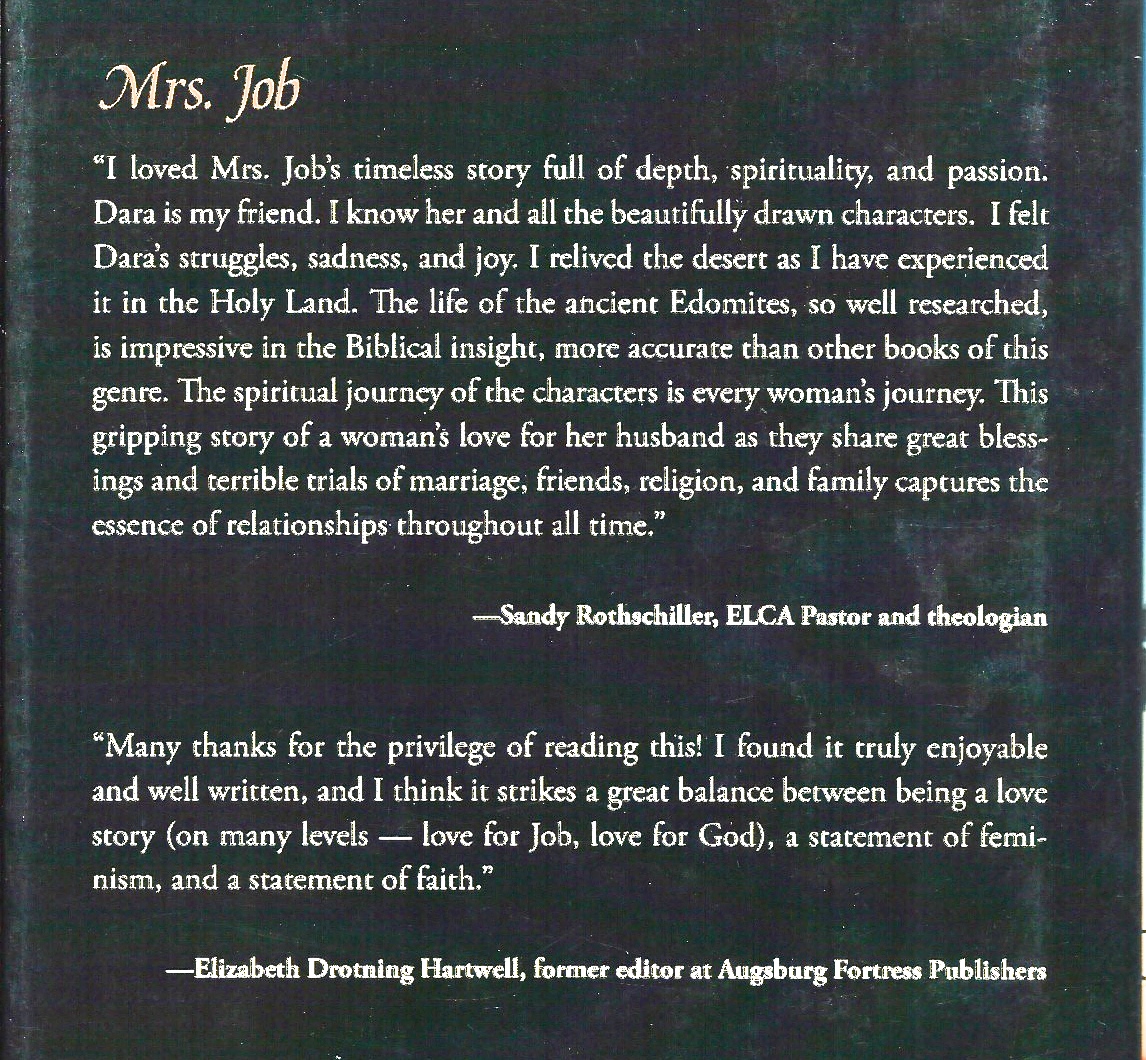
I’m including a copy here of the back cover comments. (click to make it larger.)

So why a new edition? Again, those of you who have been with me know that the big problem with “Mrs. Job” was the title. Everyone, it seems, read “Job” as if it had to do with paid employment, rather than the book of Job, one of the books of wisdom in the Hebrew Testament. Also, given that I left the Ph.D. after my name, people took it to be one of a few things: A self-help book for married women seeking paid employment; a heavy psychological tome; a – liberal, or maybe fundamentalist – rant.
But it’s none of those things. It is the love story of fictional Dara, the wife of Biblical Job, from her childhood and lifelong friendship with Adah, through her marriage to Job, the growth of family and wealth, through the biblical trials and their aftermath.
The cover of “Mrs. Job” is lovely, but “Figs & Pomegranates & Special Cheeses” will be more romantic and colorful, more likely, I hope, to grab the eye and illustrate the basics of the story.
I’ll bet you’re thinking I’m in danger this time that the book will be filed in the cookbook section. I’m hoping not. My expectation is that the visual cover and the full title will help to avoid that.
As for the source of the new title. It comes from her mother’s words in a conversation they have shortly before Dara’s marriage.
“Oh Dara, I did feel that way
about your father when we first married,
but love changes over time.
I guess you could say at first it is like
feasting on figs and
pomegranates and special cheeses,
and later it is like enjoying the
evening potage. The thrill may not be
so great later on, but each day it fills
the empty hole that would be hunger
if you did not have each other.”
Push the Forgiving One Page at a Time button/photo to the left of this post and you’ll find the option to buy a signed copy of a modified version of When to Forgive.
Including less detail, and fewer case stories, it provides a way for you to work very directly with your own forgiveness issues.
Amazon..com advertises an e-book version which has one review – mine, which tells you not to buy the e-book. Why? Because it defeats the purpose, and the publisher did it in spite of my objection.
That’s because the book is designed to be your own workbook/journal. After a general introduction, it includes written material on the left hand page, and guides on the right hand page for you to enter your own reactions/situation.
Like When to Forgive it’s purpose is to help you make your own decisions about whether to forgive and how. Like the larger book, it helps you take into account the reaction you can expect as a result of what you decide and do.
If you’d like to see reviews of this book, go to amazon.com
If it’s all the same to you, however, I’d appreciate your buying directly from me.
I’m including a photo below of the comments on the back cover.
One person called me with a report but refrained from posting it on amazon. What he said pleased me, though. He said he and his wife had an argument just before she left for a meeting. Restlessly angry, he picked up a copy of forgiving One Page at a Time which was lying on the table. “I went through most of it,” he said, “and then called her to apologize.”
One never knows what reactions will result when someone explores his or her own distress over a perceived injustice.

I believe clicking on this image will enlarge it. (I hope so, anyway.)n
A brilliant guru at Joyful Computing has figured out how to place “buttons” by means of which one can order my books from my blog. Actually, it’s not a button that one clicks on, but a photo of the book included to the left of the post (not the photo in the header). Starting with today’s entry, I’d like to highlight each of my available books, one post at a time.
During my final years on the faculty of Southern Connecticut State University my special area was the Psychology of Women. I’ll talk about that influence in a subsequent blog on “Mrs. Job.” But today it’s “When to Forgive.”
Happily when I retired from SCSU I was in a position to work on another area of professional interest – the Psychology of Forgiveness. The result of that focus was “When to Forgive,” today’s topic.
Not the newest of my books, I’ll alert you up front that it is the most expensive, the price being set by the publisher, New Harbinger. It has been around long enough to move from a price tag of $13.95 to $16.95. (oops! amazon.com is offering a discounted price of $14.34. If you’d like a signed copy from me at that price, please contact me via the e-mail button below the button photos.)
There has also been time for it to accumulate some comments in addition to those offered at the time of its publication. For example the following, which I have been given permission to quote:
“Written just for me! Thank you Dr. Affinito. Your book on forgiveness must have been written just for me. After reading just the first chapter, I realized just how much I have been punishing myself with my need to immediately forgive others. Now I realize that I need to go through the process, just like mourning. I went out and purchased a journal and gave myself permission to take the time and energy necessary to understand why I felt the way I do and to discern what I want to happen in the end. I’m buying this book for many of my friends and my wife is already anxious to take my copy – but I think I’ll buy her a copy of her own. Just a great resource to reflect and go back to time and time again”
As for comments at the time of publication, I’m posting a link to the amazon.com back page. You’ll find reader reviews there too.
I believe what sets “When to Forgive” apart from other forgiveness books is just what the comment above implies. It isn’t a “You must forgive” argument. It is, rather, a guide to making the reader’s own decision about whether to forgive, and how. It is also unique in providing a definition of forgiveness. It might not be the definition on which everyone would agree, but for one who works through this book it provides clarity of meaning and goal.
In the process of writing it I sought out, and sometimes just happened to discover, stories of forgiveness of all kinds of offenses. Many of them are provided as examples.
I hope this helps you decide whether you want to click on the “When to Forgive” photo to order a copy.
This would also be a great opportunity to comment on your own experiences with forgiving — or deciding not to.
In my next post I’ll give details on “Forgiving One Page at a Time.”
Last evening I finally got my DVD working and watched a program on Forgiveness. Unfortunately I was alone at home, so there was no one with whom to share my distress. So now you are it.
The problem with the topic of forgiveness is that people are talking about all kinds of things. Not just apples and oranges, but throw in some carrots and tomatoes too
So, here are some things that distressed me. One person thought that forgiving meant not getting angry. WRONG. Anger is the first step – well, maybe the second – in a long tough process of deciding whether to forgive, and if so, how.
Another person thought forgiving meant saying what the other person did was all right. WRONG. If you think the other person did nothing wrong, then there’s nothing to forgive. No, forgiveness happens, if you choose it, because the offender did something wrong.
Some seemed to think that forgiving means the lawbreaker will pay no price for the crime. WRONG. You are not the legal system, though these days you certainly do have an opportunity to influence it. You can forgive, relieving yourself of the negative effects of un-utilized anger, without preventing appropriate legal penalties.
And that brings me back to anger. What a gift! What a motivator! The issue is not to avoid or deny anger, but to harness it.
Some thought they couldn’t forgive unless the offender requested it and showed sufficient remorse. That may be the truth for some people, but it has its negative effects. Mainly the loss of power. As long as you are waiting for the person who hurt you in the first place to take action, you are powerless, stuck with your anger and pain.
One more thing I noticed. A couple of people said murder was unforgiveable because the person who was hurt is dead and therefore can’t act. But the truth is, the murder of one person has a wide-ranging effect on loved ones, fellow workers, the larger community. The killer has hurt each of those people. Each one has the right to forgive – or not.
There’s more, but I’ll stop here. My point is that the decision whether to forgive – and how – is a long, complicated personal process. And yes, I did say “whether” to forgive. That’s the point.
And as I see people wrestling with these problems, I can’t help wanting to make sure they are aware of my two books on forgiving. The point in both of them is to help readers make their own decisions. No speeches, just guidance through the options and considering the outcome of one’s choices.
I’ve got to find out how to put a PayPal button on my blog. In the meantime, Please reduce my stress and yours by checking out When to Forgive and Forgiving One Page at a Time”
By the way, if you decide to buy “Forgiving One Page at a Time,” don’t choose the kindle edition. I tried to stop the publisher from turning it into a kindle book. It won’t work, because it really is fashioned as a diary with some points and questions on the left hand page and a place for your own entries on the right.
One last thing. If you have an opinion about either of the books, please do share it in the comment section.
Thanks
Sometimes the past appears in the present pulling the present into the past like the motion of an accordion. That happened for me last night at a very moving presentation of Dubois’ “Seven Last Words of Christ” at Mount Calvary Lutheran Church in Excelsior, Minnesota. The sanctuary was full and darkened, lit primarily by seven candles in front of the bare altar. The choir was full. The organ, the drum, and the harp were near perfection, as were the four professional soloists and the choir itself.
As each “word” was completed, one candle was extinguished and, for the finale, the choir sang in the dark without music. No one broke the silence in the end as we left.
For me, it was not just beautiful. I relived the years of singing one of the soprano solos in Hamden, Connecticut. But more than that I saw and heard the conducting organist, long gone from us, and the other friends no longer in my life, and many gone on to the next stage in their journey.
The day before yesterday we had celebrated Maundy Thursday where we received the new commandment to love one another. Yes, the accordion effect last night did flood my soul with love that survives even the death of those who have blessed our lives and moved on.



 monagustafsonaffinito