Archive for the ‘forgiveness’ Tag
I know, I skipped a couple of these updates. Lots of things fattened my schedule of things to do — like a couple of blogs on “A Healthy Woman is a Crazy Person.” And, of course, doing my best to get the word out about “Figs & Pomegranates & Special Cheeses.”
I’m happy to say the book has now accumulated 19 reviews. People seem to like the option of the Kindle version — certainly a lot less expensive than the paperback, which also is set at a pretty comfortable price.
I’ve also had some direct sales of signed copies. That could happen for you too if you send me a request, with your snail mail address, at figs@forgivenessoptions.com. The price is $12.95 + $3.00 postage (+ $0.81 tax if you are in Minnesota).
I’d love to cooperate with someone local who might like to have a home reading for the book. (and maybe my other books on forgiveness.)
As for the web site, it is still slow in the making. The talented man who is putting it together had to take time out for health reasons, and I’ve been slow in providing him the materials he needs. I hope soon he and I will be rolling along to the final accomplishment. Once that’s up and running, you’ll be able to order any of my books via that route.
I have sent out close to 100 postcards asking people to check out the book on amazon, and the reviews, and send me an e-mail at figs@forgivenessoptions.com telling me they’ve done it. I gather from some of the personal reactions that my terrible handwriting is standing in the way — like people can’t read what I’ve asked them to do.
Anyway, I still have hundreds of postcards left if you have any great suggestions for me.
Oh, by the way, one of the time-consumers is “My Father’s House,” the fictionalized version of the biography of my father. Right now a couple of volunteers are giving me some great feedback on a sample of the first 27 pages. I’ve asked for people who are not of Swedish heritage and who do not know me to read it just from the point of view of seeing if it is an interesting read. So far, very helpful and positive reactions.
I just finished reading “Quiet: the power of introverts in a world that can’t stop talking” It helps to explain why I find this business of marketing “Figs & Pomegranates & Special Cheeses” so frustrating. I think I’m a closet introvert. That is, I want to stay closeted and write. Well, along with a few other things. like seeing clients, and stuff.
I did write a review of “Quiet …”, lost no doubt amid the 2,990 already there. And I’d be happy with 50. Oh well…
Marketing is frustrating because it takes me away from what I really want to do. What do I want to do?
I want to work on “My Fathers House.”
And a remake of “When to Forgive” now that all rights have been returned to me. I want to do it as an e-book, with a title something like: “Forgive Now? Forgive later? Forgive Never?”
And finish up work with the web designer and get the show on the road with forgivenessoptions.com.
But soon, before my birthday passes, I want to finish preparing these postcards

 saying “Please help me celebrate my October birthday by “looking inside” the book, reading the reviews, and sending me an “I did it” message on my special “figs” e-mail address figs@forgivenessoptions.com” (Feel free to do that yourself if you are willing.)
And oh yes, I’d like to do an audio version of “Figs.. “ in addition to the paperback and the kindle. But there’s no sense doing that until sales take off.
Today, though, I’d like to share another review that couldn’t make it onto amazon.com.
Jo (no, I don’t know her personally) had this to say. “figs & pomegranates and special cheeses” is a delightful easy read. While I am not usually drawn to biblical books I found this book to be insightful and historically accurate. The character development is excellent. It’s a timeless love story based on commitment and traditions.”
I like this review because it’s a reminder that one doesn’t have to be biblical to enjoy the story.
I felt cheated. I mean, who wouldn’t like to see a review as nice as this one that appeared on my blog.
“I just finished reading Figs & Pomegranates & Special Cheeses, and wanted to let you know how much I enjoyed it. I particularly liked how you skillfully told the riveting story of how Dara evolved and grew over the years. The story is wonderfully grounded by Dara’s love for Job, and her bold words and actions. I enjoyed seeing how you handled the tensions that emerged as Dara sought to understand her role and her husband’s God.”
At my request the author agreed to post it on amazon.com and did everything right. Found “Figs & Pomegranates & Special Cheeses” and clicked on “write a review.” Completed the information to establish an account. Then was told one wasn’t allowed to post a review since there had been no purchase made with that account. No, it wasn’t necessary to have purchased that book, but just something.
I trusted my fellow blogger. Still, it didn’t seem right to me, so I called amazon. It’s true. If you haven’t purchased anything with your account you can’t use it to write a review. “It’s for your protection,” I was told.” Suppose someone wanted to ruin you, he could just establish 100 accounts and use them to write bad things about you.”
Huh? OK, does that mean this person who hated me so much could buy a $0.99 kindle book with each of those accounts. Less than $100. Not a bad investment if you’re really out to get me.
I suspect there might be a better way to protect me.
As it stands, I guess that means every time someone buys a book from me, I should ask whether or not he or she has ever bought anything from amazon. If the answer is “no,” then I should include a check for $0.99 with the book in case they want to write a review. That would give them the wherewithal to purchase something allowing for the review. OK. I confess I’m being snarky.
The words used when I first heard this are not acceptable to the nice people here in the Midwest. “Oh, my, now I have to work on forgiving them, I thought.” On second thought, though, it wasn’t a personal attack on me, though it felt that way. It’s a policy that ends up hurting me.
And amazon really does provide a number of helpful services.
So, forgiveness process ended at the first step. It wasn’t really an offense against me.
But disappointment remains. Reviews of “Figs & Pomegranates & Special Cheeses,” (or any books, for that matter) are really important to the author.
Push the Forgiving One Page at a Time button/photo to the left of this post and you’ll find the option to buy a signed copy of a modified version of When to Forgive.
Including less detail, and fewer case stories, it provides a way for you to work very directly with your own forgiveness issues.
Amazon..com advertises an e-book version which has one review – mine, which tells you not to buy the e-book. Why? Because it defeats the purpose, and the publisher did it in spite of my objection.
That’s because the book is designed to be your own workbook/journal. After a general introduction, it includes written material on the left hand page, and guides on the right hand page for you to enter your own reactions/situation.
Like When to Forgive it’s purpose is to help you make your own decisions about whether to forgive and how. Like the larger book, it helps you take into account the reaction you can expect as a result of what you decide and do.
If you’d like to see reviews of this book, go to amazon.com
If it’s all the same to you, however, I’d appreciate your buying directly from me.
I’m including a photo below of the comments on the back cover.
One person called me with a report but refrained from posting it on amazon. What he said pleased me, though. He said he and his wife had an argument just before she left for a meeting. Restlessly angry, he picked up a copy of forgiving One Page at a Time which was lying on the table. “I went through most of it,” he said, “and then called her to apologize.”
One never knows what reactions will result when someone explores his or her own distress over a perceived injustice.

I believe clicking on this image will enlarge it. (I hope so, anyway.)n
A brilliant guru at Joyful Computing has figured out how to place “buttons” by means of which one can order my books from my blog. Actually, it’s not a button that one clicks on, but a photo of the book included to the left of the post (not the photo in the header). Starting with today’s entry, I’d like to highlight each of my available books, one post at a time.
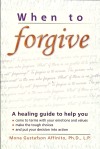
During my final years on the faculty of Southern Connecticut State University my special area was the Psychology of Women. I’ll talk about that influence in a subsequent blog on “Mrs. Job.” But today it’s “When to Forgive.”
Happily when I retired from SCSU I was in a position to work on another area of professional interest – the Psychology of Forgiveness. The result of that focus was “When to Forgive,” today’s topic.
Not the newest of my books, I’ll alert you up front that it is the most expensive, the price being set by the publisher, New Harbinger. It has been around long enough to move from a price tag of $13.95 to $16.95. (oops! amazon.com is offering a discounted price of $14.34. If you’d like a signed copy from me at that price, please contact me via the e-mail button below the button photos.)
There has also been time for it to accumulate some comments in addition to those offered at the time of its publication. For example the following, which I have been given permission to quote:
“Written just for me! Thank you Dr. Affinito. Your book on forgiveness must have been written just for me. After reading just the first chapter, I realized just how much I have been punishing myself with my need to immediately forgive others. Now I realize that I need to go through the process, just like mourning. I went out and purchased a journal and gave myself permission to take the time and energy necessary to understand why I felt the way I do and to discern what I want to happen in the end. I’m buying this book for many of my friends and my wife is already anxious to take my copy – but I think I’ll buy her a copy of her own. Just a great resource to reflect and go back to time and time again”
As for comments at the time of publication, I’m posting a link to the amazon.com back page. You’ll find reader reviews there too.
I believe what sets “When to Forgive” apart from other forgiveness books is just what the comment above implies. It isn’t a “You must forgive” argument. It is, rather, a guide to making the reader’s own decision about whether to forgive, and how. It is also unique in providing a definition of forgiveness. It might not be the definition on which everyone would agree, but for one who works through this book it provides clarity of meaning and goal.
In the process of writing it I sought out, and sometimes just happened to discover, stories of forgiveness of all kinds of offenses. Many of them are provided as examples.
I hope this helps you decide whether you want to click on the “When to Forgive” photo to order a copy.
This would also be a great opportunity to comment on your own experiences with forgiving — or deciding not to.
In my next post I’ll give details on “Forgiving One Page at a Time.”
Last evening I finally got my DVD working and watched a program on Forgiveness. Unfortunately I was alone at home, so there was no one with whom to share my distress. So now you are it.
The problem with the topic of forgiveness is that people are talking about all kinds of things. Not just apples and oranges, but throw in some carrots and tomatoes too
So, here are some things that distressed me. One person thought that forgiving meant not getting angry. WRONG. Anger is the first step – well, maybe the second – in a long tough process of deciding whether to forgive, and if so, how.
Another person thought forgiving meant saying what the other person did was all right. WRONG. If you think the other person did nothing wrong, then there’s nothing to forgive. No, forgiveness happens, if you choose it, because the offender did something wrong.
Some seemed to think that forgiving means the lawbreaker will pay no price for the crime. WRONG. You are not the legal system, though these days you certainly do have an opportunity to influence it. You can forgive, relieving yourself of the negative effects of un-utilized anger, without preventing appropriate legal penalties.
And that brings me back to anger. What a gift! What a motivator! The issue is not to avoid or deny anger, but to harness it.
Some thought they couldn’t forgive unless the offender requested it and showed sufficient remorse. That may be the truth for some people, but it has its negative effects. Mainly the loss of power. As long as you are waiting for the person who hurt you in the first place to take action, you are powerless, stuck with your anger and pain.
One more thing I noticed. A couple of people said murder was unforgiveable because the person who was hurt is dead and therefore can’t act. But the truth is, the murder of one person has a wide-ranging effect on loved ones, fellow workers, the larger community. The killer has hurt each of those people. Each one has the right to forgive – or not.
There’s more, but I’ll stop here. My point is that the decision whether to forgive – and how – is a long, complicated personal process. And yes, I did say “whether” to forgive. That’s the point.
And as I see people wrestling with these problems, I can’t help wanting to make sure they are aware of my two books on forgiving. The point in both of them is to help readers make their own decisions. No speeches, just guidance through the options and considering the outcome of one’s choices.
I’ve got to find out how to put a PayPal button on my blog. In the meantime, Please reduce my stress and yours by checking out When to Forgive and Forgiving One Page at a Time”
By the way, if you decide to buy “Forgiving One Page at a Time,” don’t choose the kindle edition. I tried to stop the publisher from turning it into a kindle book. It won’t work, because it really is fashioned as a diary with some points and questions on the left hand page and a place for your own entries on the right.
One last thing. If you have an opinion about either of the books, please do share it in the comment section.
Thanks
I’m back! I tried to stay in touch with you all while I was on vacation from this post, often with just a “like” to let you know I’m paying attention.
And now I have probably more to say than either of us would prefer, but I hope you’ll stay with me. As usual, my thoughts have been grinding away.
I just finished reading “All But My Life” by Gerda Weissmann Klein, the memoir of a young woman born in Poland in 1924 who endured and survived the brutality and slavery of the Nazi holocaust. Because she is such an excellent writer, one feels the abject misery and humiliation without her ever telling us what we should be feeling. Just the direct reporting of events is all that’s needed for a powerful reminder of the abomination of which “ordinary” people are capable. And an indicator of the stealth with which the reality of developing sadism creeps up on victims who have faith in the goodness and decency of humanity.
I read it on the heels of “The Book Thief” by Markus Zusak, a fictional portrayal of the gradual involvement of “innocent” people in supporting the Nazi terror. It would be difficult, I believe, for one to read this without heightening the awareness of the ever-present threat of horror built on indifference.
These observations lead me to the quote from Pastor Martin Niemöller, who, an outspoken critic of Adolf Hitler, spent the last seven years of Nazi rule in concentration camps:
First they came for the Socialists, and I did not speak out–
Because I was not a Socialist.
Then they came for the Trade Unionists, and I did not speak out–
Because I was not a Trade Unionist.
Then they came for the Jews, and I did not speak out–
Because I was not a Jew.
Then they came for me–and there was no one left to speak for me.
Both books I’ve mentioned remind me of the potential danger in avoiding awareness and confrontation. And both books offered much in the way of analysis of personal approaches to survival.
But my purpose here is more limited to the thoughts I’ve been having about forgiveness. The person who recommended Klein’s book to me suggested it was a story of forgiveness. But I realize something different – perhaps parallel to forgiveness –was going on. The author never focuses on her anger toward her tormentors, but rather on what she can do to survive. In other words, all her energy was directed toward staying alive.
I noticed that same phenomenon at the time of the Newtown, Connecticut, massacre. When the parents of a murdered child were asked by an interviewer whether they would be able to forgive the shooter, their response was, basically, “We can’t spend our time focused on him. We have a family to care for. We need to find a way to go on, and maybe even heal.”
I think we need a new word, something like “forego-ness.” While the point of forgiveness is that it starts with blaming the offender and experiencing our anger, the two examples above demonstrate foregoing any attention to the wrongdoer. Control rested in the hands of those parents, and in the charge of author Klein. They simply bypassed the anger, the first step in forgiveness, and went directly to focusing on taking care of themselves.
I have regularly defined “forgiveness” as the decision not to punish an offender and the relief that follows. I think I should describe that relief more specifically as removing power from the offender and taking back control over one’s own life. If refusing to forgive is like locking oneself in a cell and handing the keys to the offender. Then the result of deciding not to punish is equivalent to taking the keys back.
As always, I know I have to point out this doesn’t mean one decides the offender shouldn’t pay a price, but rather that the forgiver’s life can move on without being controlled by concern for the one who caused the pain.
The metaphor for “forego-ness” would have no image of keys or cells. One simply doesn’t lock oneself in the cell in the first place.
I do hope I’ll get some comments on these ideas. And I hope the commenter will be you.
And there’s still When to Forgive and Forgiving One Page at a Time for your perusal if you choose.
Back in my college days, it was a pretty common sight to see a classmate sitting by the mailbox hoping the mailman (sic) would allow her to retrieve the letter she wrote in haste and regretted sending. Today there’s an even greater danger of doing something in haste that will be regretted later. That’s what I thought of as I decided to enter the following on my Facebook page. 4giveletGrow.
“WAIT! Don’t take action when you are in the midst of shock and pain over the wrong you have suffered. One of our forgiveness class members pointed out yesterday that e-mail heightens the danger; it’s so easy to press “send.” Wait! Process and wait!”
Today on 4giveletGrow:
“We can blame somebody and refuse to forgive him. But we cannot forgive him if we dare not blame him.” Lewis B. Smedes, page 77 in the “Art of Forgiving,” (my favorite book after my own.)
Yesterday on 4giveletGrow:
Today’s 2:00 a.m. thought. After the hurt two things are needed: grieving and rebuilding/restructuring – and they probably shouldn’t be done in the same place.
This morning I finished giving a four-session course on forgiveness to a wonderful group of about 15 people. I’ll miss them, but I’ll carry the good fruits of our relationship for a long time. And I hope they will too.
I know. I should have shared Bulgaria long ago, but the tail I’ve been chasing continues to elude me.
I have returned to entering stuff on my Facebook page, though. Please go to Facebook and search on 4giveLetGrow.
These are the entries from yesterday and today.
11/12/13: Finishing up a forgiveness course this week with a group of amazing people. One thought of many to follow. Forget about “Forgive and Forget.” You won’t forget, unless you’re extremely good at denial or repression. But you can find relief from the pain.
11/13/13: Picking up the pieces after the offense. hurt, confusion, anger — what did happen? Not at all easy, but the first step is to pull together the facts. What? When? Details. Maybe why? Any stories to share?




 monagustafsonaffinito